THANK YOU, PETER RORVIK, FOR BELIEVING IN AFRICAN CINEMA
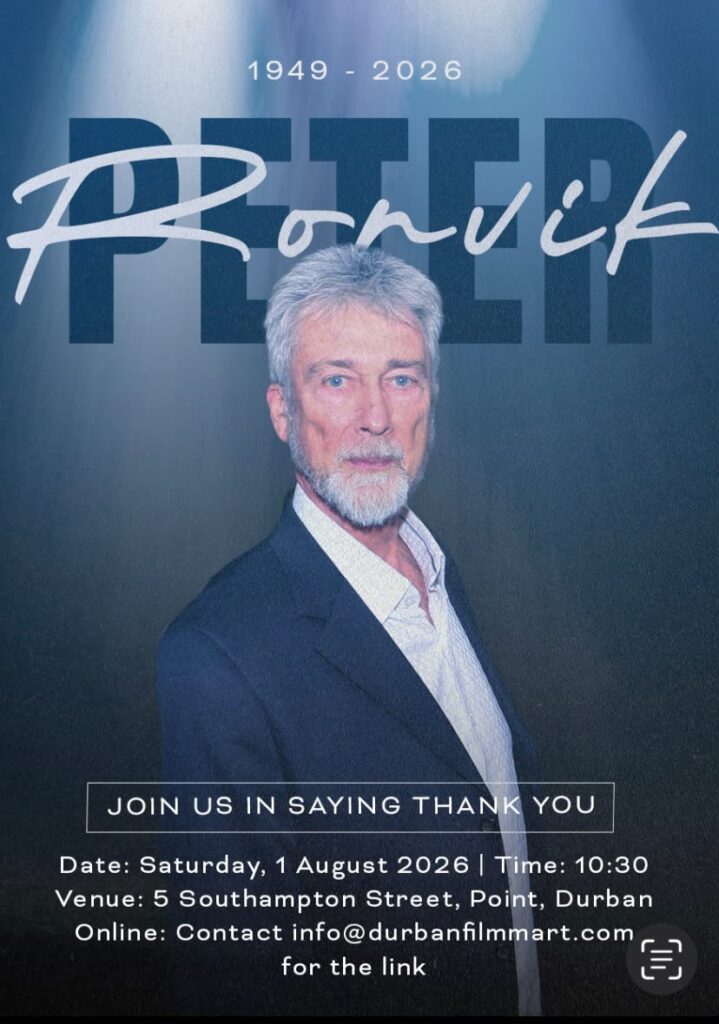
A personal tribute from Toni Monty, former Head of the Durban FilmMart and Durban Film Office.
There are people who leave behind festivals, institutions and awards. And then there are people who quietly leave behind better people. Peter Rorvik somehow managed to do both.
I first met Peter about twenty-five years ago when I joined the Durban Film Office. Long before I had the privilege of working alongside him, I admired what he had built at the Centre for Creative Arts. Under his leadership, the CCA had become home to some of South Africa’s most remarkable cultural platforms, Time of the Writer, Poetry Africa, JOMBA! Contemporary Dance Experience and, of course, the Durban International Film Festival.
Those festivals were never simply annual events. They became part of Durban’s identity. Peter understood, long before many of us did, that culture could build communities, spark dialogue and connect people across borders.
A few years later, when I was appointed Head of the Durban Film Office within the Economic Development Unit of eThekwini Municipality, my task was clear: find new ways to grow Durban’s film industry. We were competing with Johannesburg and Cape Town, both established production centres. Yet Durban possessed something neither city could replicate.
Every year, filmmakers, producers, programmers and audiences from across Africa and around the world came to Durban because of the Durban International Film Festival. Independent cinema escaped the confines of traditional theatres and spilled into courtyards, community halls and open spaces along the beachfront. I can still picture those evenings. Hundreds of people gathered beneath the night sky, watching African cinema while the full moon slowly rose over the Indian Ocean. Twenty-five years later, I still don’t think I have experienced anything more magical.
Watching those audiences, I found myself asking a simple question. How do we build on this? I approached Peter with what, at the time, felt like a rather ambitious idea. “What if we created an African co-production market alongside the festival?”
Peter looked at me with that familiar mischievous grin. “If you can find the money,” he said, “we can do it.” That was all the encouragement I needed.
About a year later, together, we announced the first Durban FilmMart. Looking back today, it is easy to think of Durban FilmMart as something that was inevitable. It wasn’t. It began as an idea shared around a table by people who believed Africa deserved a world-class co-production market of its own. Peter believed in that idea from the very beginning, not because he wanted another event, but because he understood what it could become for African filmmakers.
In the months that followed, we travelled to festivals and markets around the world, meeting festival directors, market directors, film funds, diplomats and industry partners, speaking enthusiastically about this new initiative taking shape in Durban. But my fondest memories were never the international meetings. They were the evenings spent around the boardroom table at the Centre for Creative Arts with Peter, Monica Rorvik, Magdalene Reddy, Sharlene Versfeld and Nashen Moodley.
Those meetings developed their own rhythm. Monica invariably arrived carrying enough snacks to sustain discussions that often stretched late into the evening. There always seemed to be fresh coffee. Around us hung decades of festival posters while shelves overflowed with programmes, catalogues and carefully labelled archive boxes. Peter insisted that everything be preserved. At the time, I simply thought he was meticulous. Looking back, I realise he understood something much deeper.
Institutions need memory. Sitting in that boardroom never felt like sitting in an office. It felt like sitting inside the living history of African cinema. It felt, quite simply, like love.
Of course, we did not always agree. There were spirited debates, moments of frustration and the occasional clash of strong opinions. Yet somehow, by the end of every meeting, Peter would quietly guide us back to the reason we had all come together in the first place. That was where I received one of the greatest educations of my career.
Peter taught me the true meaning of collaboration. He taught me that whenever disagreement arises, and it always will, you return to the centre. You put personalities aside and ask one simple question: Does this serve the purpose that brought us together in the first place?
Peter never seemed interested in winning arguments. He was interested in serving the work. He was always the calm in the storm. I was young, enthusiastic and, if I am honest, sometimes rather headstrong.
Peter never denied me the vision. Instead, on more than one occasion, he quietly invited me into his office for a conversation. He never told me my ideas were impossible. He simply showed me a better way of bringing people along on the journey. He taught me not just how to build institutions. He taught me how to build them with people. I have carried those lessons with me ever since.
Peter had a remarkable ability to make people feel that their contribution mattered. Whether you were an internationally renowned filmmaker, a first-time intern, a government official or a volunteer helping prepare a venue, he treated people with exactly the same courtesy and respect. Looking back, I think that was one of his quiet superpowers. He built institutions by first building people’s confidence in themselves.
I remember seeing Peter genuinely angry only once. A filmmaker had been treated unjustly. The injustice affected him so deeply that I scarcely recognised him. It struck me because it was so rare. Peter never seemed interested in fighting battles for himself. But he would never quietly accept injustice towards someone else. In an industry often filled with large personalities and even larger egos, I never once saw Peter place his own ahead of the collective good.
He also possessed one of the driest senses of humour imaginable. During the months leading up to the first Durban FilmMart, I was so excited that I seemed determined to issue a press release for every milestone we achieved. The first partners. The first call for projects. The first adjudication panel. Eventually my telephone rang. “Toni,” Peter began with complete seriousness, “I appreciate that you’re excited…” There was a pause. “…but do we really need a press release for every single step?” Another pause. “What’s next? ‘The readers are reading. The posters are printing?” I burst out laughing. I still laugh whenever I think about that conversation. That was Peter. He possessed the rare ability to gently redirect someone without ever making them feel diminished.
As Durban FilmMart matured, our weekly meetings continued, but increasingly Peter simply trusted me to get on with the work. During the festival we would sometimes go days without seeing one another because he was immersed in the Durban International Film Festival while I was consumed by Durban FilmMart. Yet somehow I always knew he was there. Occasionally we would cross paths between screenings or evening events. We would quietly check in with one another, exchange a brief update, make sure everything was alright, and then disappear back into the organised chaos of the festival. Those moments seem incredibly precious now.
When Peter retired from the Centre for Creative Arts, I could scarcely imagine either the Durban International Film Festival or Durban FilmMart without him. Yet perhaps that was his greatest achievement. He never built institutions that depended upon him. He built institutions that could outlive him.
Peter believed in structure. He believed in systems. Nothing escaped his attention. No press release was published before his careful eye had reviewed it. He would immediately notice a missing acknowledgement, a misplaced logo or, more often than not, an unnecessary ampersand.
But beneath that meticulous attention to detail lay something far greater. Peter believed that everyone deserved to be acknowledged. No contribution was too small. No person was invisible. It is little wonder that those who worked alongside him loved him so deeply.
Peter’s contribution to South African and African cultural life has rightly been celebrated through the many festivals, institutions and networks he helped build. Those achievements deserve every accolade they receive.
But the Peter I will remember lives somewhere else. He taught me integrity without self-righteousness. Humility without weakness. Leadership without ego.
He taught me that institutions are built through relationships. That collaboration requires generosity. That purpose must always be greater than personality.
Today, much has changed. Peter had retired to Cape Town. The Durban International Film Festival continues. Durban FilmMart continues. Others, myself included, have handed the work on to a new generation.
Sometimes I find myself thinking back to those evenings in the CCA boardroom, the coffee, Monica’s snacks, the festival posters lining the walls, the archive boxes stacked around us, the spirited debates that somehow always found their way back to common purpose. At the time, we thought we were building Durban FilmMart. Looking back, I realise Peter was building something much larger. He was building us.
Whenever I find myself navigating difficult decisions, trying to build consensus or reminding people to return to the purpose that first brought us together, I still hear Peter’s quiet voice. His lessons never really left me. The memories still play in my mind like an old film reel, the boardroom conversations, the debates, the laughter, the careful edits, the quiet wisdom, and Peter at the helm, humbly.
Thank you, Peter.
For believing in African cinema. For believing in people. For teaching us that the strongest institutions are not built by the loudest voices, but by the quiet, generous and steadfast people who dedicate their lives to others.
Rest peacefully, my friend.
As published by Durban Filmmart